
What to check on your dog's paws between grooms
Feet are where most of the notes we send home come from. They are also the part of a dog people check least, partly because a lot of dogs do not enjoy having them held. Two minutes a week, on a dog that has been taught to accept it, catches nearly everything.
The two-minute check
Lift a paw and look at four things.
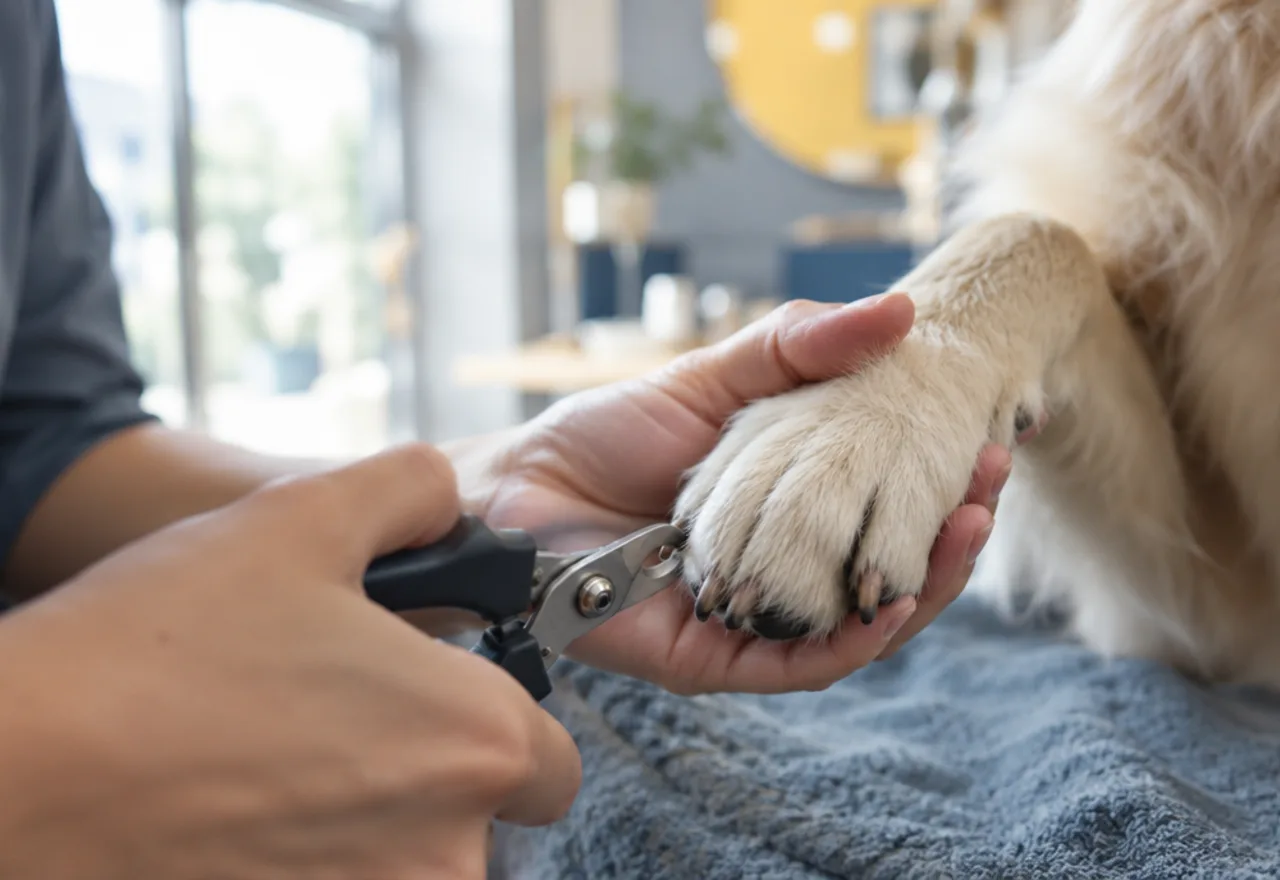
Nails. Stand the dog square on a hard floor. If you can hear the nails, or see them touching the ground, they are long. A long nail pushes the toe up and back at every step, which changes how the dog stands and, over months, how it uses its shoulders and hips. Old dogs that have gone slow on walks are sometimes just uncomfortable on their feet.
Between the pads. Hair grows down there and mats into a hard pad of its own, which the dog then walks on like a stone in a shoe. In summer it catches grass seeds, which burrow. In winter it balls up with snow and grit.
The pads themselves. They should be firm and matt. Cracked, shiny, or worn smooth is worth a look. So is any single pad that is redder than the others.
Between the toes. Redness, a wet patch or a lump between the toes is usually either a seed that has gone in or an interdigital cyst. Both need a vet, not a groomer.
The one thing worth doing yourself
Nails, if the dog will let you, and only the tip. Little and often — a millimetre every week — beats a big trim every eight, because the quick recedes as the nail shortens. Take a sliver, stop, treat. If your dog has black nails and you cannot see the quick, do the tiniest amount you can be bothered to and come to us for the rest.
We do nails as a walk-in, no appointment, and it takes about five minutes.
What we do at the table
Every full groom includes nails, a pad trim and a check between the toes. If something looks wrong you get a note about it when you collect, with as much detail as we can give. We are not vets, and we will not tell you what it is — but you will know it is there, which is the part that matters.